The Terrarium Fill Plan
Fill a glass terrarium from its real shape: the room the plants get first, one reservoir depth, each layer's liters in a jar, a globe or a tapered pot, the soil in whole bags, and the water the reservoir can hold
TerraGlass's three most used calculators work out a vessel's volume, split its height into the four terrarium layers, and turn a drainage depth into liters to buy. Writing this plan, we chained them the way the site's own guides did and they planned a jar you could not plant: the layer calculator split the height to the rim, the two calculators gave two reservoir depths for one jar, and floor area times depth overstated the bottom of a globe. We fixed all three; this plan carries them through to the vessel you own. In the worked 20 by 30 cm jar the old chain put 30 cm of layers in a 30 cm jar; the plan fills a third, keeps one 2.5 cm reservoir, and leaves 19 cm for the plants, with a bill of $12.48 against $21.47 at example prices. In a 25 cm globe it works every layer over the cap at the bottom (0.23 L of drainage, not 1.57 L), and shows the reservoir holds about 92 mL of spare water at an example 40% air space. Every figure in it is an example for you to replace, computed by the same code the calculators run; the one-third fill and the settling allowance are called rules of thumb. Inside: seven steps, four printable working pages, reference tables and a quickstart, plus a personalised sheet worked from the vessel you entered on the calculator. Plants and glass only: it covers no animal care, and points you to the ASPCA's plant list if pets share your home.
Look inside
Two full pages from the plan, exactly as printed. Click either to read it at full size before you decide.
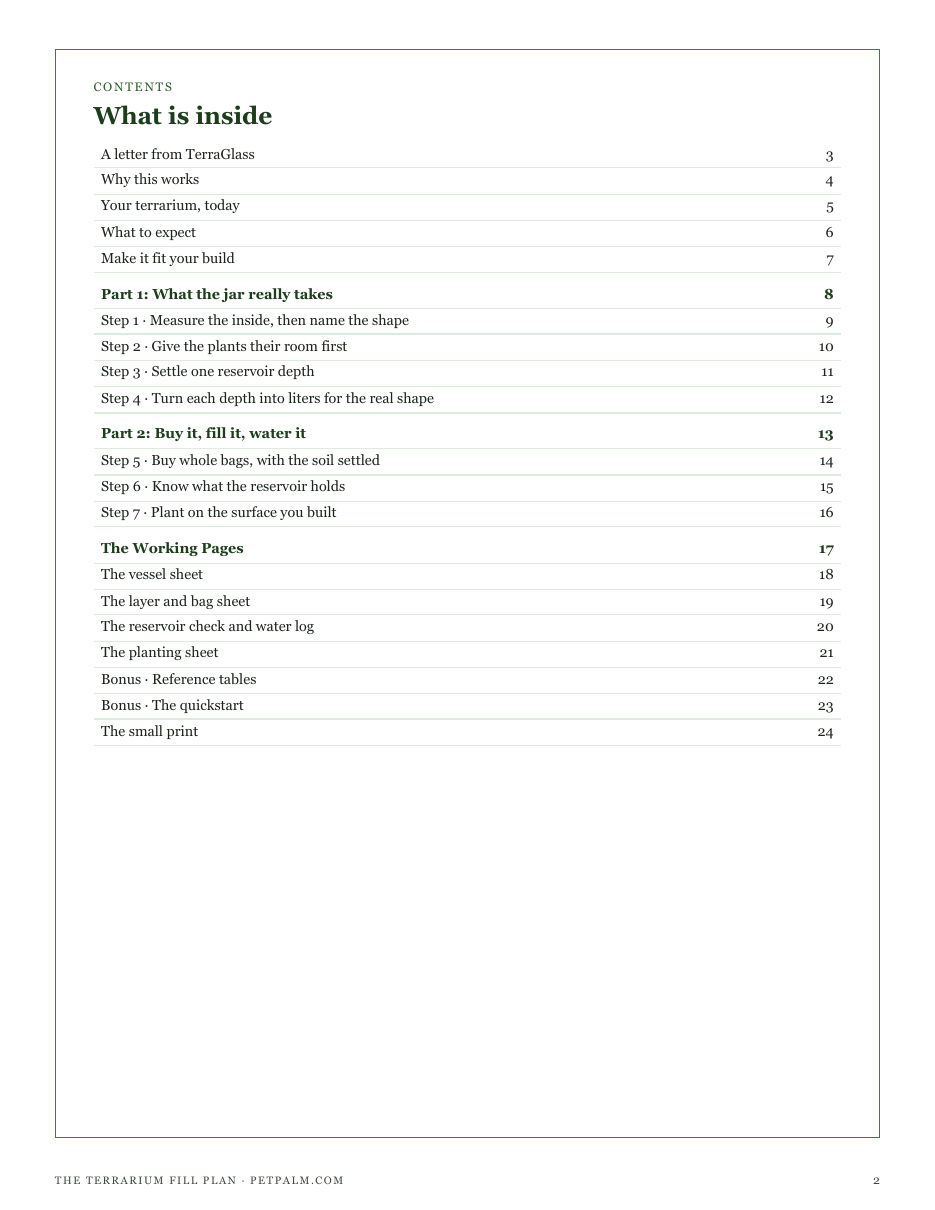
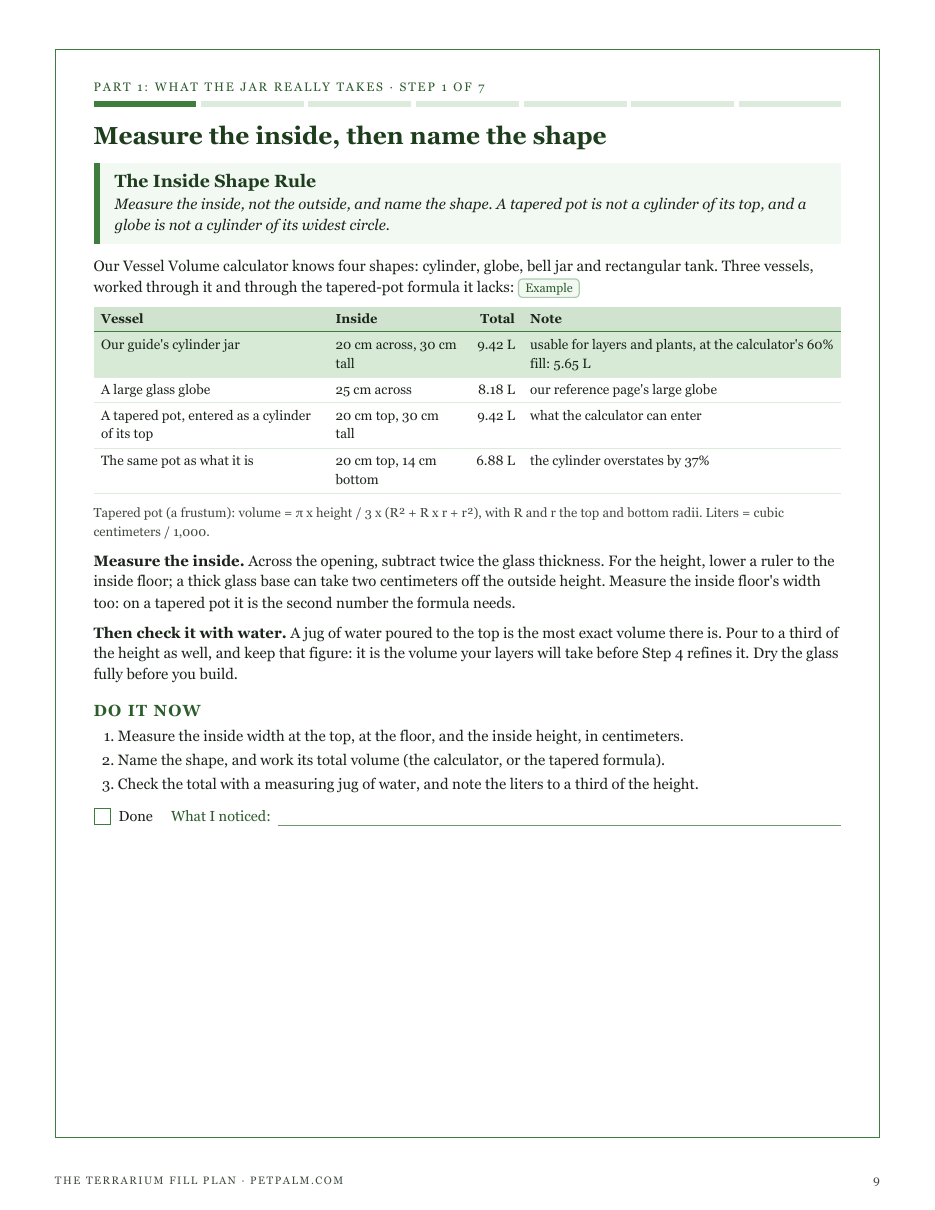
What is in it
- The Inside Shape Rule: the inside measured, the shape named, and a tapered pot worked as what it is
- The Headroom Rule: the plants' room decided first, and the layer stack set at a third of the height
- The One Reservoir Rule: one reservoir depth for one jar, and no reservoir in a pot with a hole
- The Real Shape Rule: each layer's liters worked at the height it sits, in a jar, a globe or a tapered pot
- The Whole Bag Rule: liters into the unit on the bag, settling counted, whole bags and the cheapest combination
- The Reservoir Rule: the air space measured, the reservoir's capacity, and a half-depth line on the glass
- The Surface Rule: plants and moss counted on the surface they root in, layer lines taped, every plant checked
- Working pages: a vessel sheet, a layer and bag sheet, a reservoir check and water log, and a planting sheet
- Reference tables: liters per centimeter of depth, the bottom of a globe, the calculators' layer shares, and bags in liters
- A quickstart, and a personalised sheet worked from your own calculator inputs
- ✓ 24 printable pages
- ✓ 10 sections, worksheets and templates
- ✓ A second PDF worked out from the numbers you enter
- ✓ No account needed, just an email address
- ✓ Instant download; link valid 7 days
Price includes any taxes. Sold by GrabURL, who handle checkout and support. The charge appears on your statement as GrabURL.
The plan picks up where the free Substrate Layer Ratio Calculator leaves off. That calculator splits a fill height, a third of the container by default, into drainage, charcoal, soil and top dressing, with the reservoir from the Drainage Layer Calculator, which sizes a straight-sided jar, a globe or a tapered pot over its own shape. The plan carries them through: the room the plants get first, every layer’s liters worked over the real shape from the Jar & Vessel Volume Calculator, the soil rounded up to whole bags with a settling allowance, the reservoir’s water capacity from a void share you measure, and the planting surface at the top of the stack. Every figure in it is an example for you to replace. It covers plants in glass, not keeping animals; check every plant on the ASPCA’s toxic and non-toxic plants list if pets share your home.